

A roof is a structural system, not just a covering, and understanding roof framing parts helps you discuss options, read plans and make safer choices for your house roof. The framing transfers loads from the roof coverings into the roof structure, through the exterior walls, and down to the slab or footings. When framing is sized and connected correctly, the roofing system has the structural integrity to handle wind loads, rain and the extra weight of maintenance workers or solar gear, while also supporting proper ventilation and a durable roof deck or battens under the chosen roofing materials.
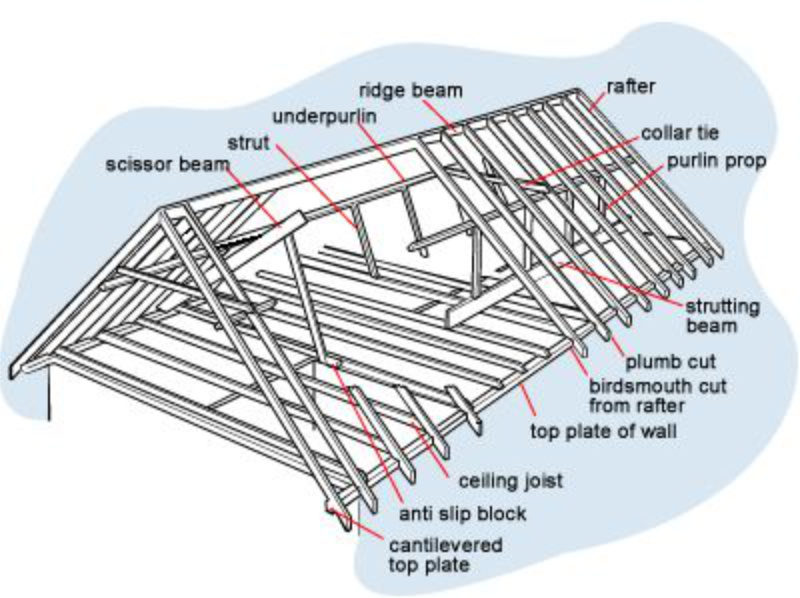
What are the main parts of roof framing called?
The key components are the ridge, rafters or roof trusses, ceiling joists, beams, posts, purlins, bracing, battens, sarking or roof sheathing, fascia and soffit. In a pitched roof these elements connect opposing rafters at the highest point, tie the walls, and create a continuous path for loads to travel to the footings. Tile and metal roofing usually sits on battens above sarking or a breathable membrane, while decked roofs use plywood or OSB roof sheathing beneath shingles or other coverings.
Key components and their roles
- Ridge: the horizontal line at the top that aligns inclined beams and sets the roof’s geometry.
- Rafters or trusses: sloping members that carry heavy loads from the roof to the wall plate.
- Ceiling joists: horizontal timber members that tie load bearing walls and create attic space.
- Beams and posts: larger elements providing support over openings and transferring forces to the ground.
- Purlins and struts: secondary framing that supports longer rafter runs.
- Bracing and tie downs: resist lateral forces and uplift in wind.
- Battens and sarking or sheathing: support the roof coverings and control water flow and airflow.
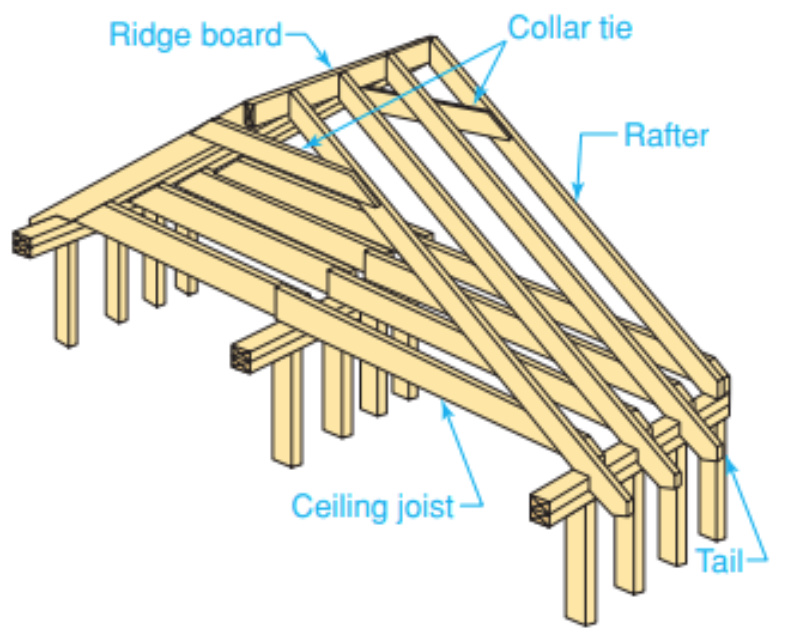
What is the difference between rafters, trusses and joists?
Rafters are cut and assembled on site, trusses are off site factory engineered triangles, and joists are horizontal members that stop walls from spreading and carry the ceiling. Stick framing with rafters gives flexibility for custom shapes, dormers and complex gable or hip roof details. Roof trusses speed installation, span further with less timber and keep performance predictable. Ceiling joists create platforms for insulation and storage in the attic space and are crucial for structural stability in a framed roof.
Quick comparison
- Rafters: cut on site, suit custom roof styles, require more labour and bracing.
- Trusses: engineered to Australian Standards, faster to erect, excellent strength to weight.
- Joists: tie the structure at the eaves line, provide a base for ceilings, help prevent sagging.
For whole-roof upgrades, colour changes and leak fixes that keep structure intact, see Roof Restoration.
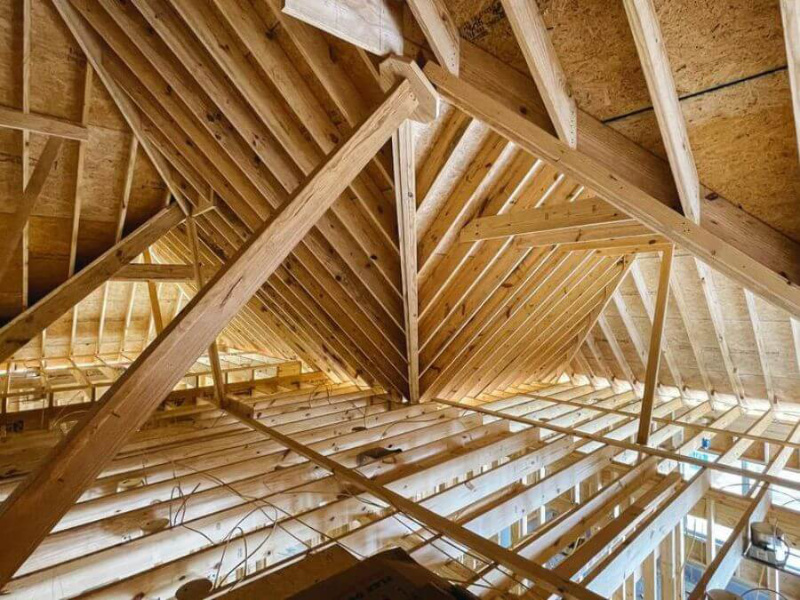
How does roof pitch affect framing?
Roof pitch changes member size, spacing and connections. Steeper slopes increase rafter length and wind uplift, so tie downs and connections must be stronger. Lower pitch needs stiffer members, closer spacing and careful waterproofing to prevent leaks. Minimum pitch also varies by roofing material. Metal panels can run at lower pitch with correct laps and fixings, while many tiles require a steeper angle for reliable water shedding. For material-specific rules and trade-offs, see Tile Roofs vs Colorbond Roofs.
Pitch design checkpoints
- High pitch: longer inclined beams, higher wind loads, stronger tie downs.
- Low pitch: larger or closer members, stricter underlay details to keep water out.
- Material limits: confirm pitch rules for metal roofing versus tiles.
What is a ridge board vs a ridge beam?
A ridge board is a non structural alignment piece for opposing rafters, while a ridge beam is a structural member that supports rafters and must be carried by posts or walls beneath. Use a ridge beam when architectural layouts remove joists or when you cannot connect opposing rafters across the span. Always confirm the bearing path down to footings.
Field checks
- Identify whether plans call for a ridge board or ridge beam.
- Ensure posts are securely fixed and sized to carry heavy loads.
- Trace load paths to footings, not just to ceilings or lintels.
How does load path work in a roof structure?
A roof’s loads travel in sequence: from the roof coverings to battens, into rafters or trusses, through beams and load-bearing walls, and finally down to the slab or footings. A continuous load path with rated connectors keeps forces in plane, prevents local failures and protects the roof during storms. If you are unsure about your home’s structural chain, book an assessment via Why Do I Need a Roof Inspection.
Load path essentials
- No gaps in the chain of members and connectors from ridge to foundations.
- Tie downs and bracing sized to wind classification and terrain.
- Corrosion resistant fasteners in coastal exposures.
What are common roof framing connectors and fasteners?
Hangers, straps, cyclone ties, brackets, nails, screws and bolts resist uplift, shear and sliding. Connector ratings must match site conditions, member sizes and the design in the truss or engineering plans. In marine zones use treated timber and compatible coatings to reduce corrosion.
Connector checklist
- Joist hangers and truss brackets for seated connections at beams and ledgers.
- Cyclone ties and straps at rafters, top plates and posts to handle uplift.
- Bolts and coach screws where engineered connections are specified.
What are purlins, collar ties and rafter ties
Purlins run horizontally to support rafters, collar ties connect opposing rafters high in the span, and rafter ties connect low near the wall plate to stop walls spreading. Collar ties are typically placed in the upper third of the height to control uplift near the ridge. Rafter ties sit in the lower third to maintain span geometry under gravity loads.
Placement rules of thumb
- Collar ties high to stabilise the ridge.
- Rafter ties low to hold walls together.
- Purlins sized and propped according to span tables and spacing.
What lumber sizes are typically used in roof framing?
Typical roof framing uses 90 to 190 mm deep sections for rafters and joists, with larger sizes or engineered timber for beams and long spans. Capacity at a given size depends on species, grade and spacing. For longer runs or tighter deflection limits, LVL, glulam or I-joists deliver stiffness without unnecessary weight. To estimate costs for different sizes and materials, try our Cost Calculator.
Sizing and material choices
- Rafters and joists: 90 × 45 through 190 × 45 typical, per span tables and building codes.
- Beams: LVL or glulam sized for openings and cumulative tributary loads.
- Trusses: factory designed components that arrive ready to install.
What sheathing goes over roof framing?
Some systems use plywood or OSB roof sheathing to stiffen the roof deck, while many Australian roofs use sarking and battens directly under tiles or metal. The sheathing or membrane choice affects airflow, condensation control and fastener selection.
Layering options
- Tiled roofs: sarking, battens, then tiles for water shedding and airflow.
- Metal roofs: breathable underlay and purlins or battens beneath the sheets.
- Decked roofs: sheathing plus underlay beneath shingles or special membranes.
What is the role of fascia, soffit and outlookers?
Fascia caps rafter tails and carries the gutter and drip edge, soffit closes the eaves for appearance and airflow, and outlookers support gable end overhangs. Correct falls, fixings and ventilated soffits help water and air move the way they should, while outlookers prevent sagging at open gables.
Edge details to get right
- Bracket spacing and fall for gutters on fascia to manage water flow.
- Vented soffit or baffles that maintain proper ventilation at the eaves.
- Outlookers anchored back to structure to resist uplift.
How do roof types change framing parts?
A gable roof uses common rafters and a framed gable end, a hip roof adds hip rafters and jack rafters, and a shed roof is a single slope supported by a ledger or beam. Where two planes meet, valley rafters collect loads and need blocking and sized connections. Hips and valleys concentrate forces and must be detailed carefully to maintain structural stability.
By roof type
- Gable roof: ridge with common rafters, gable studs, outlookers at overhangs.
- Hip roof: hip rafters from corners to ridge with jack rafters infilling.
- Shed roof: single plane sloping from a higher ledger to a lower wall or beam.
What is the anatomy of a truss?
Top chords form the roof slope, the bottom chord acts as a tie, and the webs distribute forces through a network of triangles. Truss plates press into the timber and must match the certified design. Cutting or drilling trusses without an engineer undermines structural integrity.
Typical truss elements
- Top chords, bottom chord, web layout and heel connections.
- Bracing and restraints specified in the truss plan.
- Bearing points aligned with walls or beams below.
What basic code checks apply to roof framing?
Roof framing in Australia must comply with the National Construction Code and the relevant Australian Standards. Key checks include span limits, wind classification, tie downs, bracing and any bushfire measures. Local council requirements and exposure categories can change member sizes and detailing even when two designs look similar on paper. For material choices that interact with code and cost, see the Colorbond Roofing Cost Guide.
Compliance checklist
Site winds: Confirm wind region, terrain category and shielding for the address.
Spans and grades: Apply the correct span tables for the species, grade and spacing of rafters, joists and beams.
Connections: Size tie downs, straps and fixings for uplift and shear in the selected wind classification.
Bracing: Provide wall and roof bracing per the standard, including diaphragms and hold downs.
Bushfire zone: Add BAL measures such as ember guards, compliant sarking and metal leaf guards where required.
Durability: Select corrosion resistant fasteners and straps in coastal or industrial exposure categories.
Local rules: Check council overlays, heritage constraints and any manufacturer minimums for the chosen roofing profile.
How does roof ventilation relate to framing components
Ventilation uses intake at eaves and exhaust near the ridge, relying on clear gaps above insulation and between rafters. Balanced intake and exhaust reduces condensation, protects construction materials and supports the roofing system’s service life.
Ventilation pointers
- Keep eave vents and pathways clear during insulation install.
- Ensure a continuous exhaust path near the ridge.
- Use breathable membranes specified for the roofing type.
Roof framing terms a homeowner should know
Ridge, eave, hip, valley, gable, rake, birdsmouth, ledger, binder and nogging are the core terms you will see on drawings, quotes and compliance documents. Knowing this vocabulary makes plan reviews easier and helps you evaluate a new roof proposal or a roof replacement quote.
Plain language glossary
- Ridge: the highest point where roof planes meet.
- Eave: the edge that projects past the wall.
- Hip and valley: external and internal junctions of roof planes.
- Birdsmouth: the notch where a rafter bears on the wall plate.
- Ledger and binder: horizontal supports for framing.
- Nogging: short blocks that stiffen studs or joists.
Simple labelled diagram to include
Name the file roof-framing-diagram-ridge-to-wall-plate-perth.png and label:
- Ridge, ridge board or ridge beam, rafters, collar ties, rafter ties
- Purlins, struts, ceiling joists, beams and posts
- Bracing, tie downs, battens, sarking or roof sheathing
- Airflow arrows at eaves and near the ridge
When to bring in a pro
Any change to spans, pitch, openings or roof type needs an engineer, certified truss design or a licensed carpenter working to plans and codes. Site wind category, coastal corrosion risk and bushfire rating all affect connectors, coatings and detailing. If you are weighing up a structural repair versus a full roof replacement, an inspection will clarify risks, costs and the safest route forward.
Conclusion
Strong roof framing comes from correct sizing, continuous load paths, compliant connectors and details that respect climate and material limits.
If you want decisions tailored to Perth conditions, book an inspection to confirm spans, tie downs and ventilation paths, then choose roofing materials and details that protect both the functional aspects and the aesthetic appeal of your home for the long term.

Adam has 28 years of roof tiling and restoration experience, he has been running Fremantle Roofing Services since its inception and is still trying to improve the business and its reputation. Adam has worked on everything, Often a little grumpy before 10 am but otherwise always happy to discuss the job and explain exactly what’s going right or wrong with your roof.





Leave A Comment